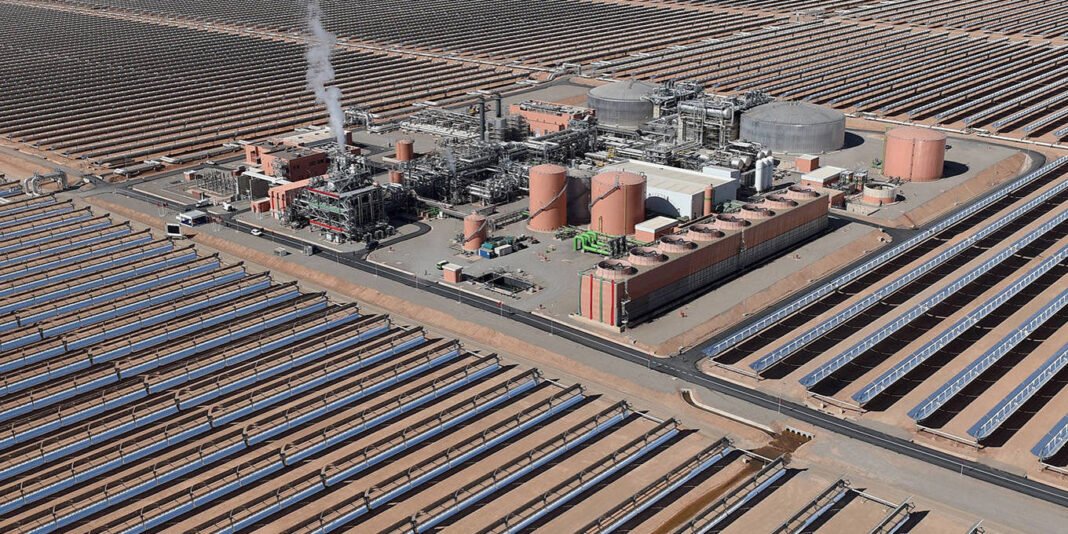

African policymakers often take a “wish list” approach to their climate-action plans, without thinking about their investment potential or how they contribute to economic transformation. But a new framework can help them identify the most promising opportunities and match them with the right type of capital.
NAIROBI/CAPE TOWN—Africa’s immense renewable-energy potential and fast-growing population offer the continent a rare opportunity to pursue economic strategies that can deliver resilient and sustainable growth. Climate action is a tremendous development opportunity for Africa, in addition to being an environmental necessity.
Michael M. Santiago/Getty Images
Is a Perfect Financial Storm Gathering?
Agustín Carstens, et al.
see a confluence of three forces that could ultimately pose a systemic risk to global financial stability.

Cheng Xin/Getty Images
The Origins and Fate of Digital Sovereignty
Robin Rivaton
Talent, capital, and large markets are not enough to create globally dominant digital champions. As the experience of China, India, Brazil, and Russia shows, domestic firms need time and space to grow before network effects lock in foreign incumbents.
explains why, contrary to economic orthodoxy, open markets consistently fail to produce homegrown tech giants.

Samuel Boivin/NurPhoto via Getty Images
The Global AI Threat Has Arrived
S. Alex Yang & Angela Huyue Zhang
The ability of Anthropic’s new AI model, Claude Mythos Preview, to find vulnerabilities across major operating systems and web browsers has dangerous implications for today’s highly interconnected world. Instead of merely securing its own firms, the United States must address the problem through diplomacy, particularly with China.
warn that Anthropic’s Mythos model will make every country more vulnerable to economic disruption.
Many African governments have already assumed a leadership role on this front. So far, 47 African countries have submitted the second round of nationally determined contributions (the decarbonization plans required under the 2015 Paris climate agreement), while 23 have submitted the third round. Their NDCs have become increasingly ambitious, with higher emissions-reduction targets, and their adaptation planning has improved.
The direction of travel is clear: Africa is laying the foundations for an era of green development. Investment flows have started to reflect this rising climate ambition, with the continent receiving around $15 billion in renewable-energy financing in 2023, more than double the previous year. But a persistent financing gap remains. In recent years, Africa has received only 11% of the $277 billion required annually to implement the NDCs and meet its 2030 climate goals.
One of the main problems is that planning has outpaced the creation of a pipeline of concrete investment opportunities—a challenge not unique to Africa. For most countries, the hardest part of the green transition is not setting targets or building frameworks but ensuring enough climate-mitigation projects into which investors can deploy capital.
Many national policymakers take a “wish list” approach to NDCs, without thinking about their investment potential or how they contribute to economic transformation. Governments undermine their credibility when they shop a long list of decarbonization ideas that do not translate into bankable projects. And when NDCs are misaligned with the broader economic-growth agenda, they are likely to cause intragovernmental disputes that stall progress. Investors often echo these concerns, describing NDCs as extensive lists of aspirations that lack clarity on prioritization and implementation.
In many cases, climate investments are capital-intensive, policy-dependent, and slow to mature. So, when countries fail to substantiate NDC commitments with investable strategies and connect them to policy reforms, fiscal allocations, and regulatory signals, assessing risk and return becomes more difficult. This reduces the likelihood of mobilizing capital, whether commercial, philanthropic, or concessional, particularly amid tightening global financial conditions.
Fortunately, African countries can close this gap by taking a practical, results-focused approach to converting NDCs into concrete, actionable plans for delivering climate resilience and economic prosperity. That means explicitly anchoring opportunities in national development and sectoral priorities. Instead of focusing on isolated projects that serve only a single climate objective, policymakers should promote those that contribute to the development of durable capabilities, value chains, institutional capacity, or key infrastructure. It also means encouraging private investment alongside public or concessional funds.
Some opportunities are already commercially attractive. Others may require blended finance, targeted policy reforms, or stronger enabling environments. And still others may have no medium-term pathway to economic viability and require the commitment of philanthropic funding. Distinguishing between these categories and matching the right type of capital to the right opportunity requires a structured, iterative approach.
That is why the African Climate Foundation, together with Dalberg Advisors, developed the NDC Investment Planner, a framework that can help governments assess the impact of mitigation and adaptation solutions, enabling a better understanding of their contribution to NDCs. The NIP facilitates systematic evaluation of these opportunities in terms of both their investment potential and their alignment with broader economic goals. This helps countries identify high-priority areas for commercial financing, which can improve project preparation, and those that require policy alignment or concessional support.
In short, the NIP is a platform for creating pipelines of investment-ready climate projects that can attract public, concessional, and private capital. The goal is to enable policymakers to strengthen coordination across government ministries and focus on opportunities that can be packaged into credible portfolios, accelerating the green transition. With this framework, partners and development-finance institutions can better align technical assistance and funding, while the private sector can engage earlier, with clearer entry points and stronger confidence in proposed projects.
From mini-grids and off-grid solar to improved agricultural inputs and green manufacturing, Africa’s climate transition has the potential to drive economic growth while strengthening resilience. But to realize this ambition, the continent must reimagine climate leadership. The challenge is not setting targets but translating them into strategies that attract the investment needed to deliver real results.
This commentary is supported in part by the African Climate Foundation.
Source:
www.project-syndicate.org